Kunming Travel Guide: Six Places Worth Visiting (with a Three-Day Itinerary)
People have called Kunming the Spring City for centuries. It sits on the middle of the Yunnan-Guizhou Plateau, the city center about 1,890 meters above sea level, the annual average temperature around 15 degrees. Summers never scorch, winters never bite, and every season is comfortable. The city's story goes back more than two thousand years, when the Chu general Zhuang Qiao marched to the shore of Dianchi, could not return home, and stayed to found the kingdom of Dian. Later dynasties all left their mark here, and during the war years the National Southwestern Associated University and the Flying Tigers brought some of the country's finest minds to Kunming. Every entry on the list below — the Stone Forest, Dianchi, Green Lake, Yunnan Nationalities Village, the Jinma-Biji Archways, and the Western Hills — has had its origins checked against public sources.
When to come to Kunming
Kunming works in any season, which is its greatest virtue. In winter, when the rest of the country huddles against the cold, Kunming still sees daytime temperatures in the teens, and every year from December to March tens of thousands of black-headed gulls fly down from the north to winter on Dianchi and Green Lake. Feeding the gulls is a fixed winter ritual here. May to October brings more rain, but also highland sunshine and mushroom season; in July and August the wild mushrooms on every street are the best thing Kunming eats all year. Summer averages just over twenty degrees, perfect for escaping the heat. If the city has one drawback, it is the wide gap between day and night temperatures, so a light jacket is never a bad idea.
Sights in the city worth a visit
Stone Forest
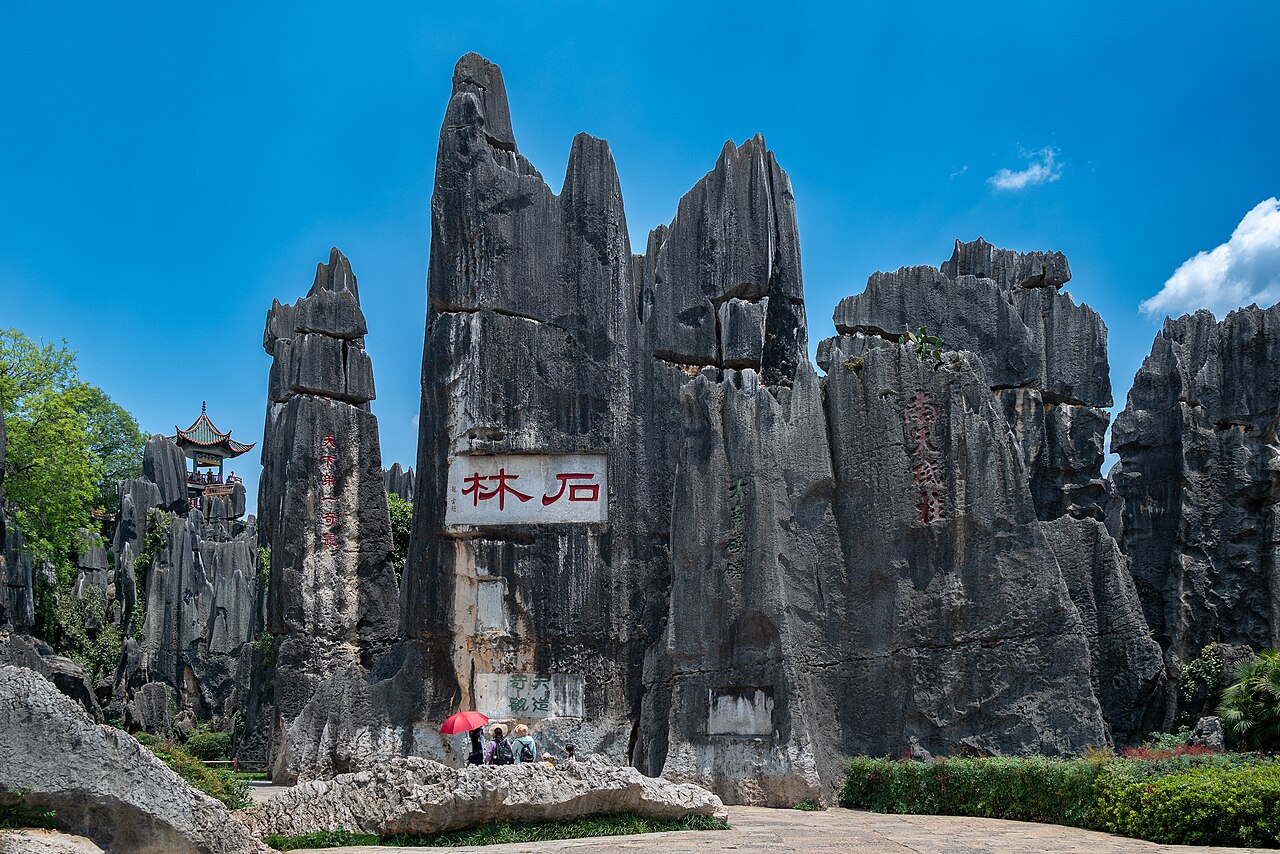
The Stone Forest lies in Shilin Yi Autonomous County, about ninety kilometers east of the city. Its official name is the Yunnan Stone Forest Scenic Area, though old Kunming hands still say Lunan Stone Forest. This is karst country: limestone laid down two or three hundred million years ago has been dissolved by water into a forest of stone, pillars standing ten meters and more in dense ranks. The Stone Forest is the homeland of Ashima in Yi legend, and the scenic area is made up of the Big and Small Stone Forests, the Naigu Stone Forest, Zhiyun Cave, Chang Lake, and Dadishui. In 1982 it became one of China's first national scenic areas, and in 2007 it was inscribed as a World Heritage site as part of South China Karst. The scene in the old CCTV Journey to the West where Sun Wukong is pinned under Five Elements Mountain was filmed here.
A day is enough for the core Big and Small Stone Forests; follow the walking route past the Ashima Rock, the Sword Peak Pool, and the other signature stones. The Yi Torch Festival falls around the 24th day of the sixth lunar month, when the area comes alive. Direct tourist buses run from the city, about an hour and a half each way.
Dianchi Lake
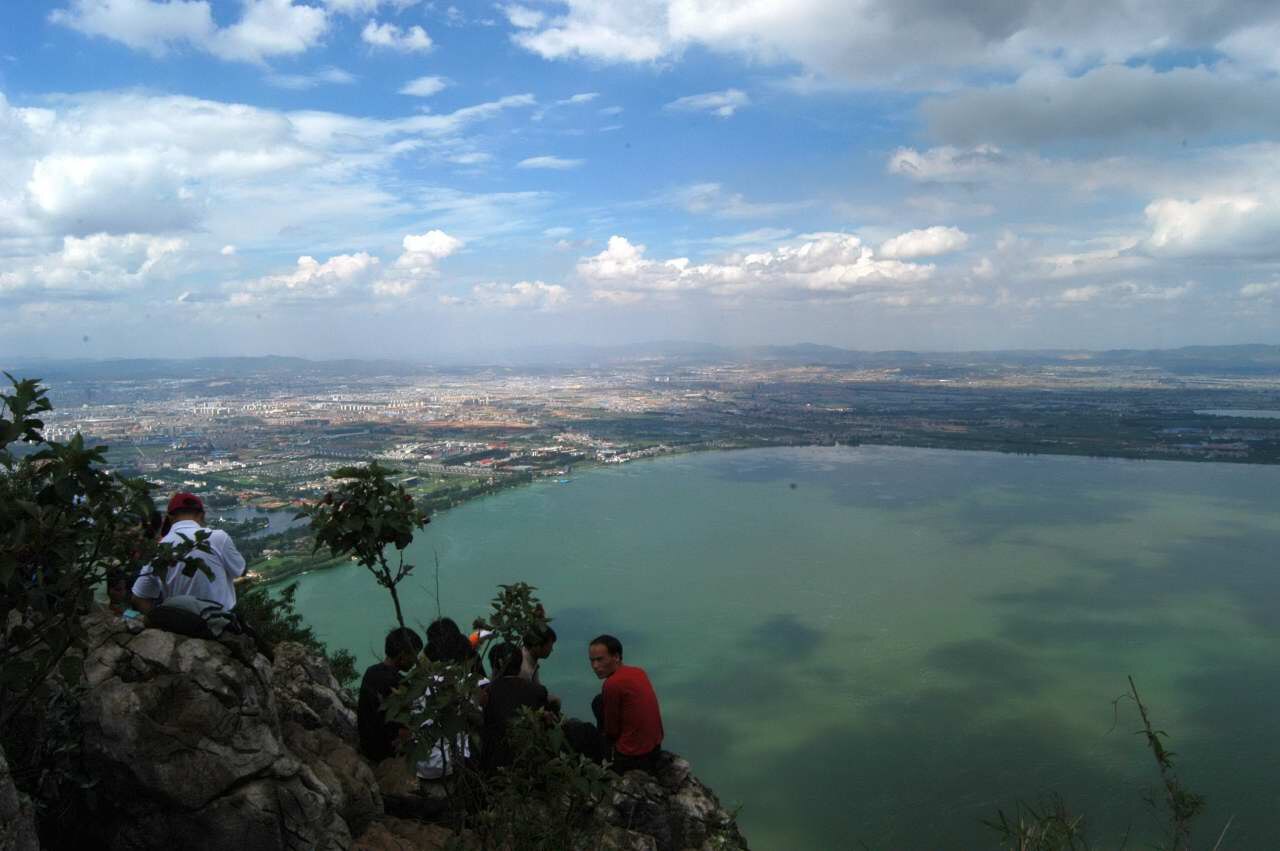
Dianchi lies southwest of the city, the largest plateau freshwater lake in Yunnan and the sixth-largest in China, its surface 1,886 meters above sea level. It belongs to the Yangtze system; twenty-nine rivers, led by the Panlong River, feed it, and the water leaves through the Tanglangchuan. Kunming grew up around this lake, the old town on its north shore.
The best way to see Dianchi is to walk along its edge slowly. In winter the lake is thick with black-headed gulls; buy a bag of gull feed, toss it into the air, and the whole flock sweeps in, the classic winter picture of Kunming. For the view from above, climb the Western Hills, where the Longmen cliffs look down over water and city spread at your feet. The Haigeng Dam on the lake shore is another favorite spot, full of kite-flyers and sunset-watchers on clear days.
Green Lake Park
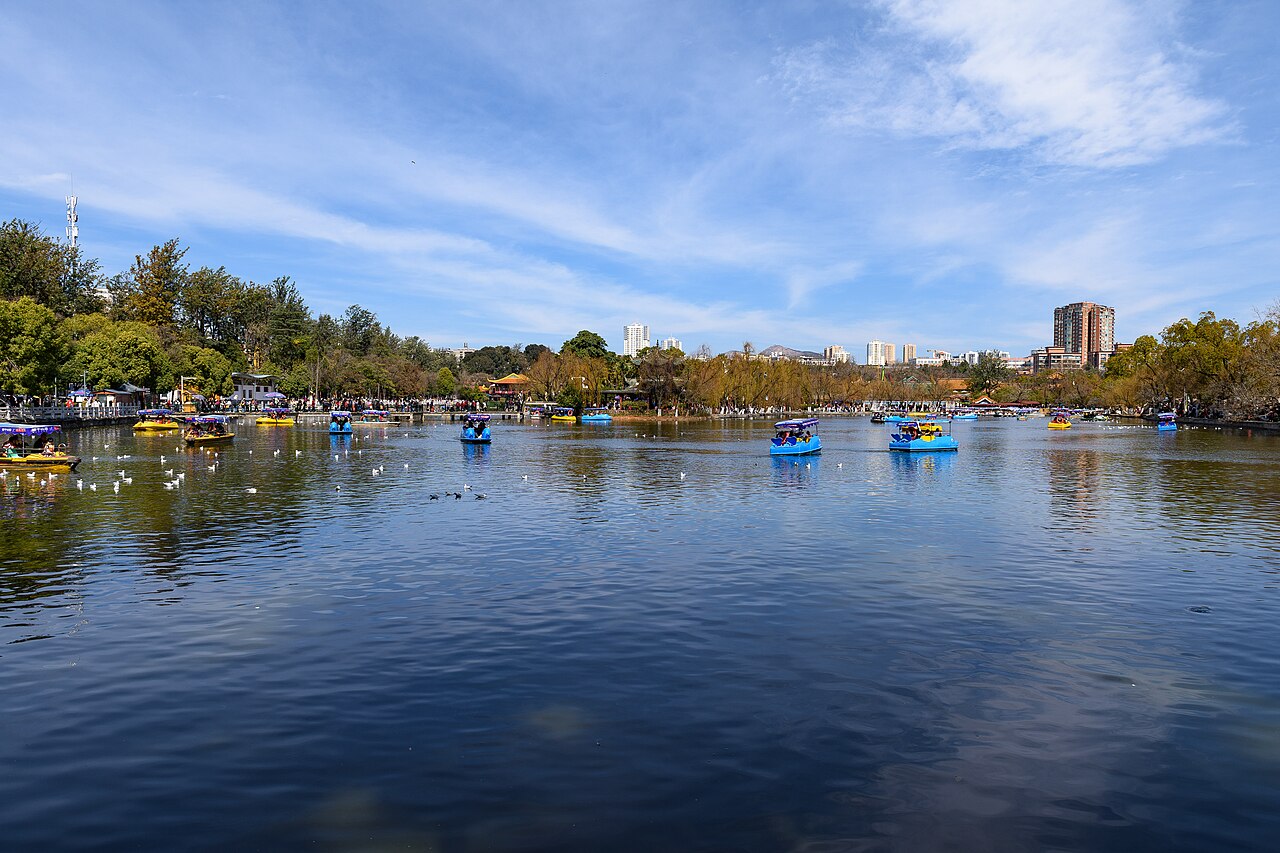
Green Lake sits in the heart of the old city, a small urban lake that carries a whole slice of Kunming history. It was once part of the ancient Dianchi; when the city wall went up in the Ming dynasty the lake was enclosed within it and became a military reserve, where the general Mu Ying planted willows and drilled his troops, leaving behind the tale of washing horses at the willow camp. In the early Qing, Wu Sangui took Yunnan, sealed off the lake, and filled in half of it to build his Honghua Palace. The swordplay is long gone now; Green Lake is where Kunming people walk and drink tea.
Winter is the lake's famous season. Black-headed gulls have arrived every year since 1985, and the shore fills with people feeding them. The park rings the lake with pavilions, willows, and teahouses, and a loop takes half an hour. Green Lake is free, and the Yunnan Military Academy site next door can be visited in the same outing. It was rated a national 3A scenic area in 2016 and joined the academy as a 4A site in 2020.
Yunnan Nationalities Village
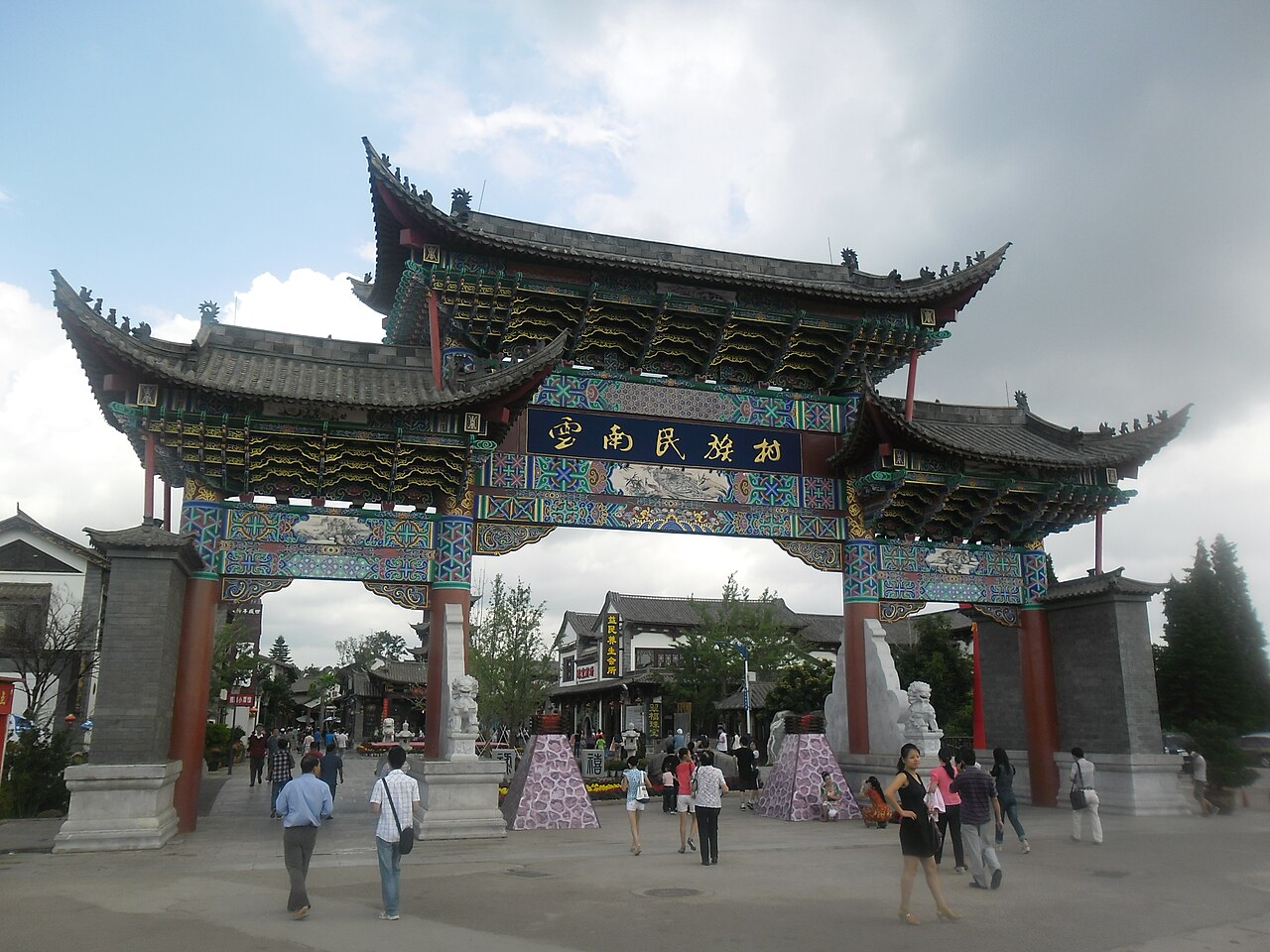
Yunnan has twenty-five indigenous ethnic groups, and the Nationalities Village gathers their settlements together on the shore of Dianchi so you can take in the essentials in a day. It is eight kilometers from the city center and covers about 1,300 mu, with dozens of open villages for the Bai, Dai, Yi, Wa, Naxi, Tibetan, and other peoples, each built in its own style with costumes, song and dance, and food on display.
The village suits first-time visitors who want an overall picture of Yunnan's many cultures before heading further out. There are scheduled ethnic song and dance performances, and festivals like the Dai water-splashing and the Yi torch festival are celebrated here too. Since it hugs Dianchi, you can go straight from the village into a lakeside stroll. The park is large, so allow half a day to a full day.
Jinma-Biji Archways
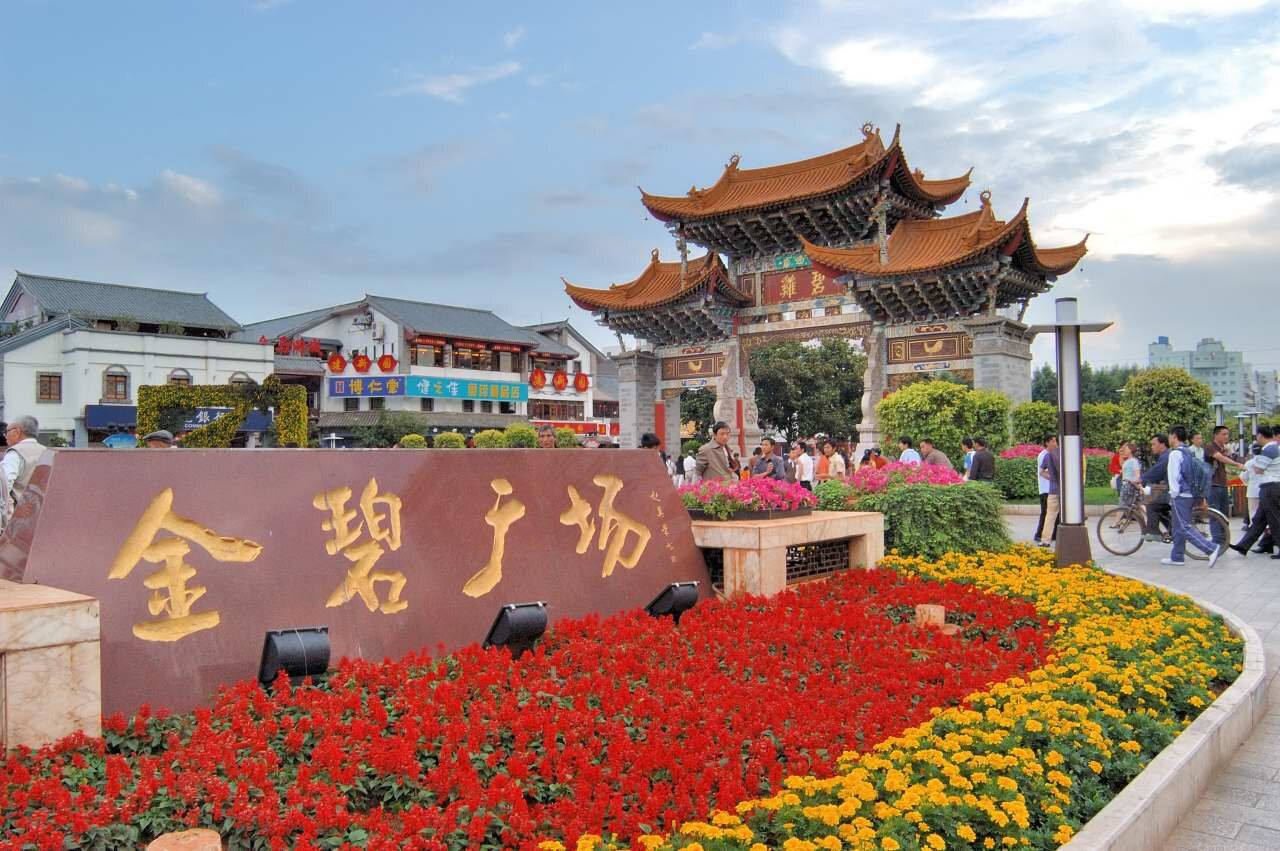
The Jinma-Biji Archways are Kunming's best-known landmark, a pair of memorial gateways standing at the junction of Jinbi Road and Sanshi Street in the city center. The eastern one is the Jinma Arch, the western one the Biji Arch, each twelve meters high and eighteen wide, a few dozen meters apart. They were first raised in the Ming Xuande reign, then destroyed and rebuilt several times over the centuries; the present structures are restorations.
The two gateways are modest in themselves, but they guard the memory of a city. This was once Kunming's commercial heart, where goods and people moving north and south all had to pass. Today the Jinbi Road area is still one of the liveliest parts of town, the archways always busy beneath, and better lit at night. They sit right in the center, so a walk through Green Lake or the old streets brings you past them without setting aside separate time.
Western Hills
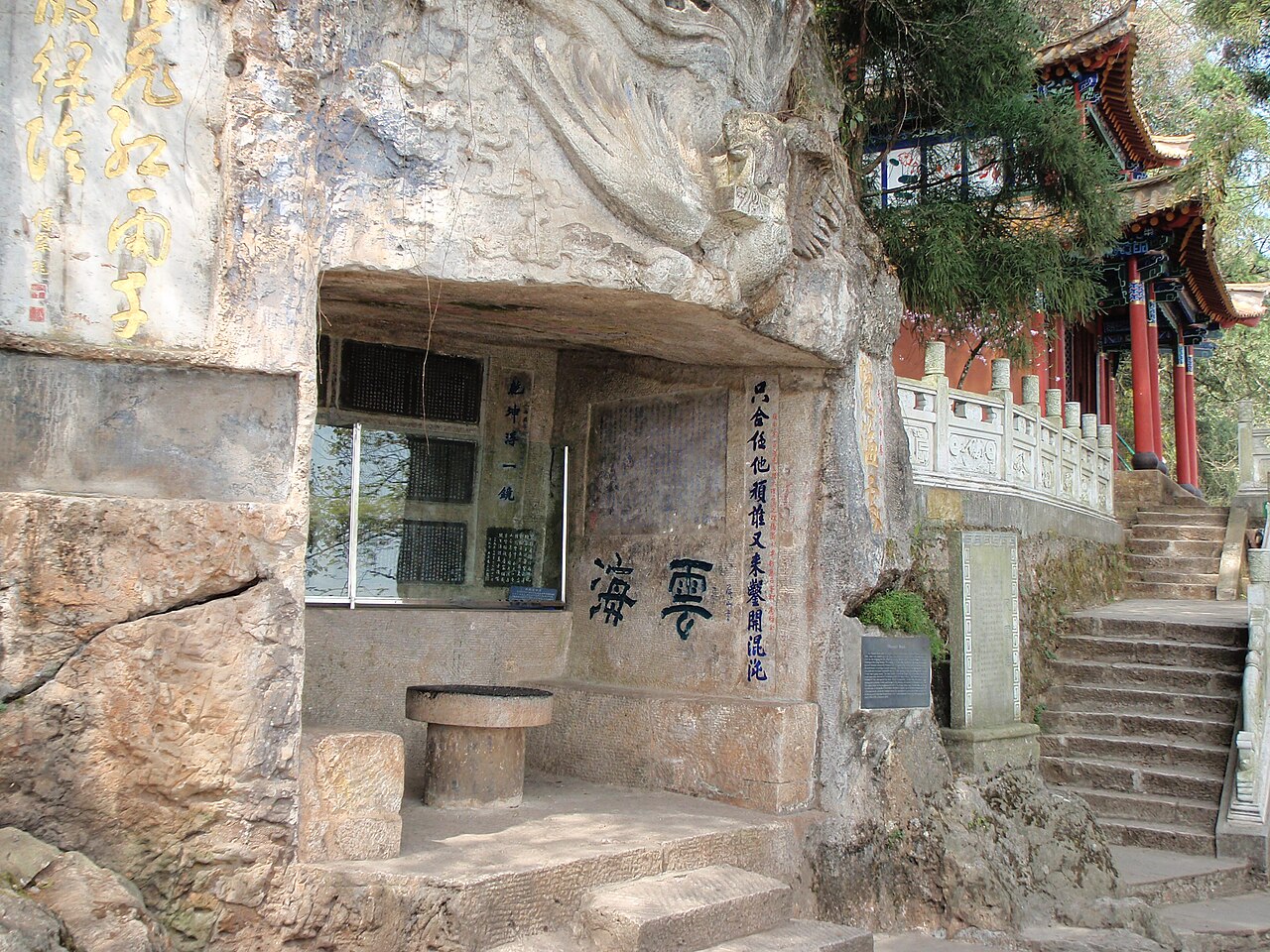
The Western Hills run along the west shore of Dianchi, a ridge stretching south into the lake. Kunming people call them the Sleeping Beauty Hills, because the ridgeline is said to resemble a woman lying down. Their most famous sight is the Longmen Grottoes — not the Buddhist Longmen of Luoyang, but a Daoist grotto complex carved into the Luohan Cliff, comprising the Old Stone Chamber, the Ciyun Cave, and the Datian Pavilion. Work began in the Ming Jiajing reign and continued into the Qing, making it the largest Daoist grotto group in Yunnan. The cliffs hold carved statues of Kui Xing, Wenchang Dijun, and other Daoist figures, the steepest section hanging over the lake below.
People climb the Western Hills for one thing: to stand at Longmen and look down on Dianchi. That view, water and city spread out at your feet, exists nowhere else in Kunming. Cable cars and buses both run from the city, and the energetic can walk up. The Huating and Taihua temples on the hill can be taken in along the way. Half a day suffices; a full day lets you go slowly.
Eating in Kunming
Kunming's food revolves around a bowl of rice noodles. Crossing-the-bridge noodles are the signature — you drop the meat and noodles into a bowl of scalding broth yourself, part ritual and part meal. Locals more often eat small-pot noodles or bean-curd noodles, a few yuan a bowl. Steam-pot chicken is cooked in a Jianshui clay pot, the broth clear and the meat tender. July and August bring wild mushrooms, the thing not to miss in Kunming: porcini, jizong, and green-head mushrooms, served in hot pot or stir-fried. Flower cakes are the standard souvenir, rose-filled and best warm. For mushroom hot pot and stir-fries, stick to reliable restaurants and never touch a mushroom you do not recognize — that is a rule Kunming people repeat every single year.
How to arrange the route
Three days covers the city and its surroundings comfortably.
Day one, arriving in Kunming: Green Lake Park first, feeding the gulls in winter, then the Yunnan Military Academy next door, then the Jinma-Biji Archways, and dinner around Jinbi Road.
Day two: the Stone Forest, out early for the Big and Small Stone Forests and back by afternoon. With energy left, catch the sunset from the Haigeng Dam on Dianchi.
Day three: the Western Hills in the morning, walking Longmen for the Dianchi view, then the Nationalities Village in the afternoon — or the reverse, the village first and the gulls on Dianchi at dusk. In three days the city and its surroundings are essentially covered.
Things to confirm before you go
- The Stone Forest is ninety kilometers east of the city, an hour and a half each way — a day trip, but leave early.
- Longmen on the Western Hills clings to the cliff, the paths narrow; mind your footing when crowded, and those afraid of heights should think twice.
- Kunming sits near 1,900 meters. Most people feel nothing, but on arrival avoid hard exertion and heavy drinking.
- Visiting in winter to see the gulls, mornings and evenings are cool — bring a jacket. Summers are rainy — bring an umbrella.
- In mushroom season, eat only at proper restaurants and refuse any species you do not know.
Frequently asked questions
How many days for Kunming?
Two days for the city and one for the surroundings makes a comfortable three. The city alone can be done in two; add the Stone Forest for three.
When are the black-headed gulls here?
From December to March, concentrated at Green Lake and Dianchi. Those months are the best for watching and feeding them.
Is the Stone Forest worth the trip?
Yes. It is a World Heritage site, a karst stone forest unlike anything else in the country, and an easy day trip from the city.
Will I get altitude sickness in Kunming?
Most people will not. The city center is about 1,890 meters, not high, and normal sightseeing is fine — just avoid strenuous exertion and rushing into alcohol.
Sources
The facts in this article were checked against the following Chinese Wikipedia entries, retrieved August 25, 2025.
- Kunming (city) https://zh.wikipedia.org/wiki/昆明市
- Stone Forest Scenic Area https://zh.wikipedia.org/wiki/石林风景名胜区
- Dianchi Lake https://zh.wikipedia.org/wiki/滇池
- Green Lake (Kunming) https://zh.wikipedia.org/wiki/翠湖_(昆明)
- Yunnan Nationalities Village https://zh.wikipedia.org/wiki/云南民族村
- Jinma-Biji Archways https://zh.wikipedia.org/wiki/金马碧鸡坊
- Western Hills Longmen https://zh.wikipedia.org/wiki/西山龙门
All photos are from Wikimedia Commons, used under CC licenses; re-use requires attribution.
- kunming-shilin.jpg from File Shilin, Yunnan 24740.jpg, by xiquinhosilva, CC BY 2.0
- kunming-dianchi.jpg from File 西山远眺滇池.jpg, by Emitchan, CC BY 2.5
- kunming-cuihu.jpg from File Southwest part of Cuihu Park, Kunming (20240214121712).jpg, by N509FZ, CC BY-SA 4.0
- kunming-minzucun.jpg from File 云南民族村-入口牌坊.jpg, by 董辰兴, CC BY-SA 4.0
- kunming-jinma.jpg from File 金碧广场.jpg, by Emitchan, CC BY 2.5
- kunming-xishan.jpg from File 普陀胜境 - panoramio - 江上清风1961.jpg, by 江上清风1961, CC BY 3.0
- kunming-skyline.jpg from File 五华区与盘龙区天际线 - 航拍 - 2025-05-16 03.jpg, by 瑞丽江的河水, CC BY-SA 4.0