Harbin Travel Guide: Five Stops in the Ice City (with a Three-Day Itinerary)
Harbin is the capital of Heilongjiang and one of China's northernmost provincial capitals, nicknamed the Ice City, though some call it the Moscow of the East. The city's history rests not on the walls of a Central Plains dynasty but on a railway — the Chinese Eastern Railway. When the Russians built it in the late nineteenth century, Harbin sprang up as a junction, and Russians, Jews, and Eastern European immigrants arrived in waves, leaving behind a city full of European-style buildings and making Harbin one of China's first international cities by the 1920s. Its annual average temperature is barely above five degrees, and the winters are long and hard — but it is exactly that cold that turned ice and snow into the city's calling card. The five places below — Central Street, St. Sophia Cathedral, Sun Island, Ice and Snow World, and the Flood Control Monument — have all had their origins checked against public sources.
When to come to Harbin
Harbin really has two seasons: the ice season, and everything else. For the full northern winter, come between December and February, when Ice and Snow World, the ice lanterns, and the snow sculptures are all open, and minus twenty or thirty degrees is the norm — dress accordingly. For comfort, come June to August; Harbin's summer is mild and short, a renowned escape from the heat, and by the Songhua River you may still want a jacket in the evening. Spring and autumn are brief transitions around the May and October holidays — visitable, but with neither ice nor full greenery. Whatever the season, the city's European streetscape is always there.
Places worth visiting in the city
Central Street
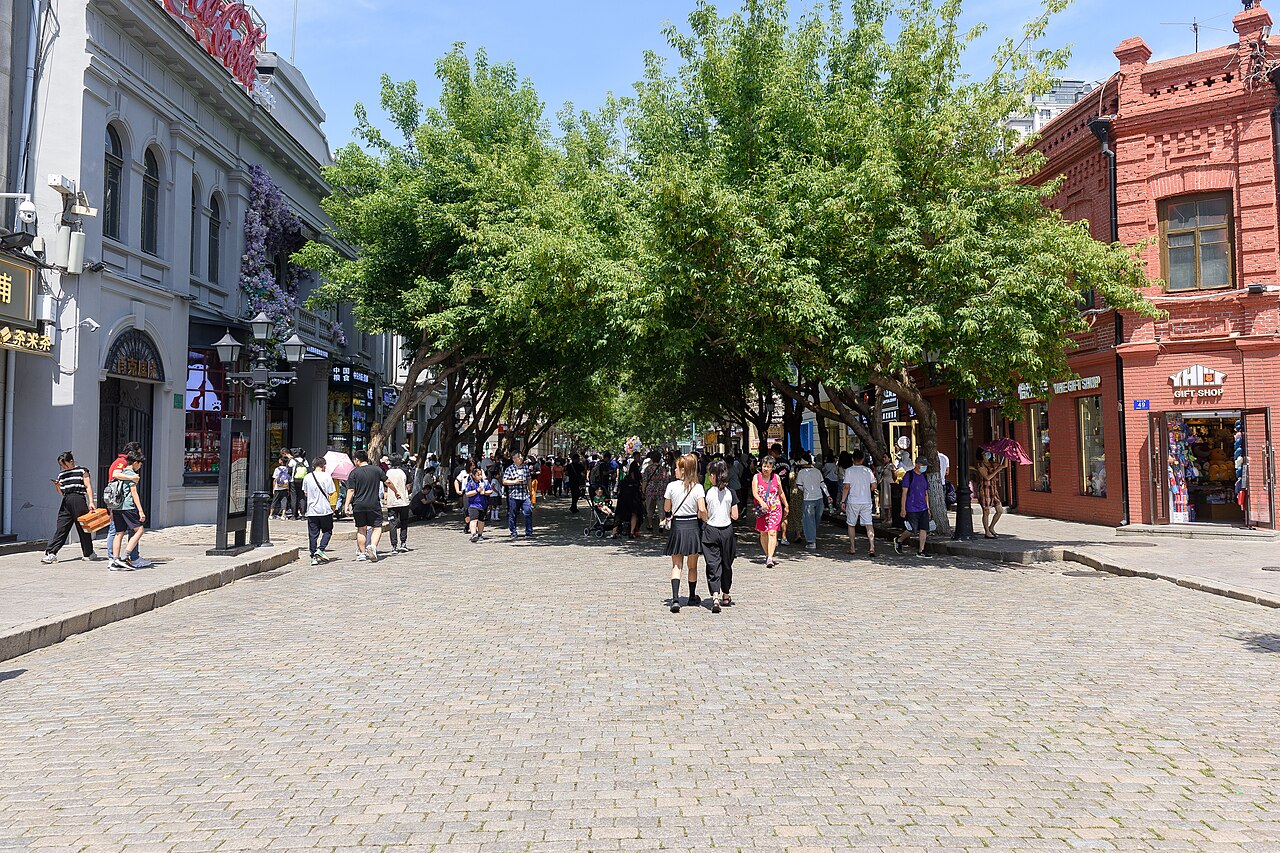
Central Street is Harbin's best-known thoroughfare, running from Xinyang Square in the south to the Flood Control Monument on the Songhua River in the north, 1,450 meters in all. The whole street is paved with square stone blocks that locals call bread stones, each one rounded, giving a distinct feel underfoot that belongs to Harbin alone. It is the longest pedestrian street in Asia, opened in 1997 as mainland China's first commercial pedestrian street, though the street itself is far older, dating to 1898, when it was still called China Street.
The point of Central Street is not the shops but the old buildings. Baroque, Renaissance, and eclectic facades stand one after another, many raised by Russians in the early last century. Lit up at night, the street is at its best. Along it sits Modern, an old Harbin brand selling ice cream bars and pastries; even at twenty below zero in winter, people queue for the ice cream, a sight in itself.
St. Sophia Cathedral
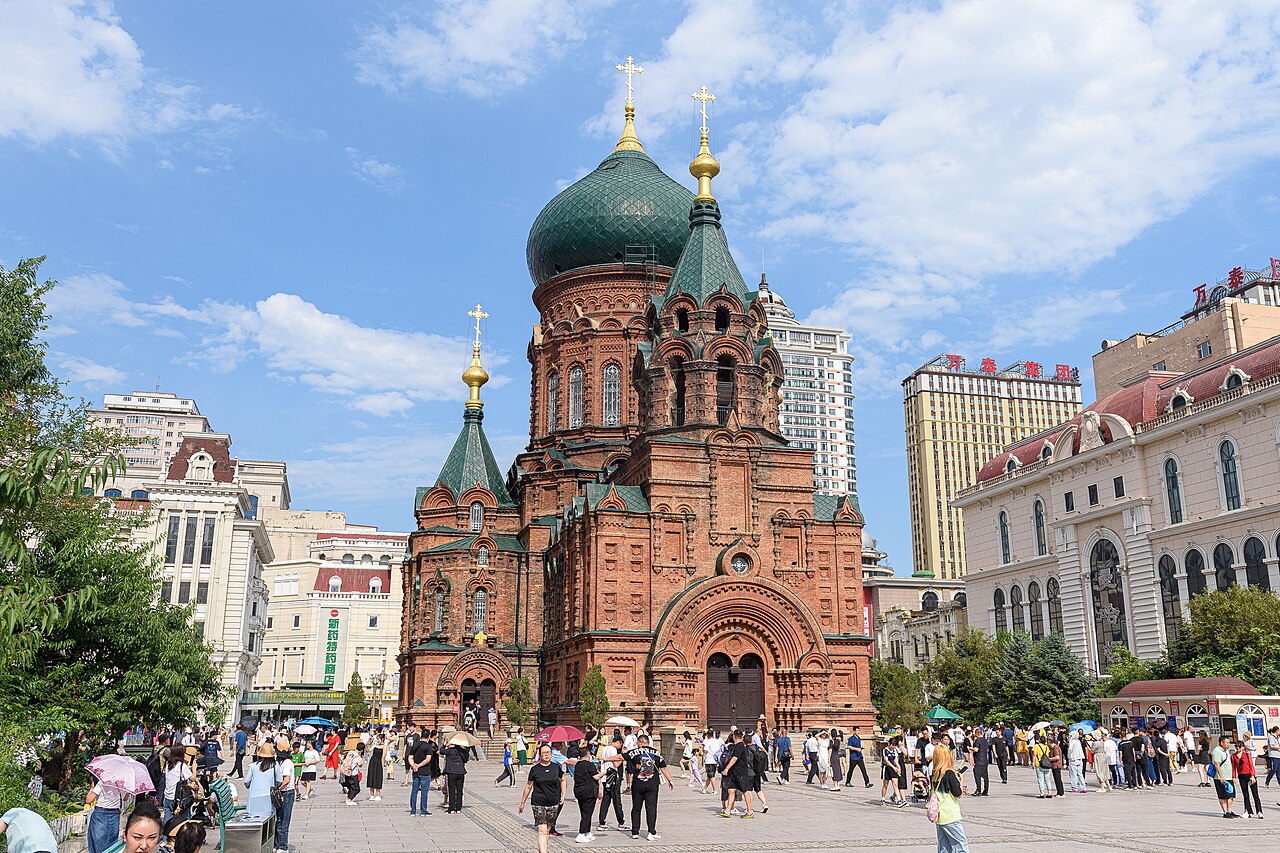
St. Sophia Cathedral stands in Daoli District, not far from Central Street, the largest Orthodox cathedral in the Far East. Its cornerstone was laid in 1907 as the garrison church of a Russian imperial infantry division, and it was enlarged over the years into the Byzantine-style building with its green onion domes seen today. The cathedral no longer holds services; it now houses the Harbin Museum of Architecture, with exhibits on the city's building history.
The cathedral's draw is its exterior — red brick walls under a deep green dome, snow-covered in winter, one of Harbin's most recognizable images. By day you can go inside for the architecture exhibition; by night the cathedral is lit and the square fills with photographers. The full facade is visible from the square for free, with a ticket only to go inside. It is a few minutes' walk from Central Street.
Sun Island
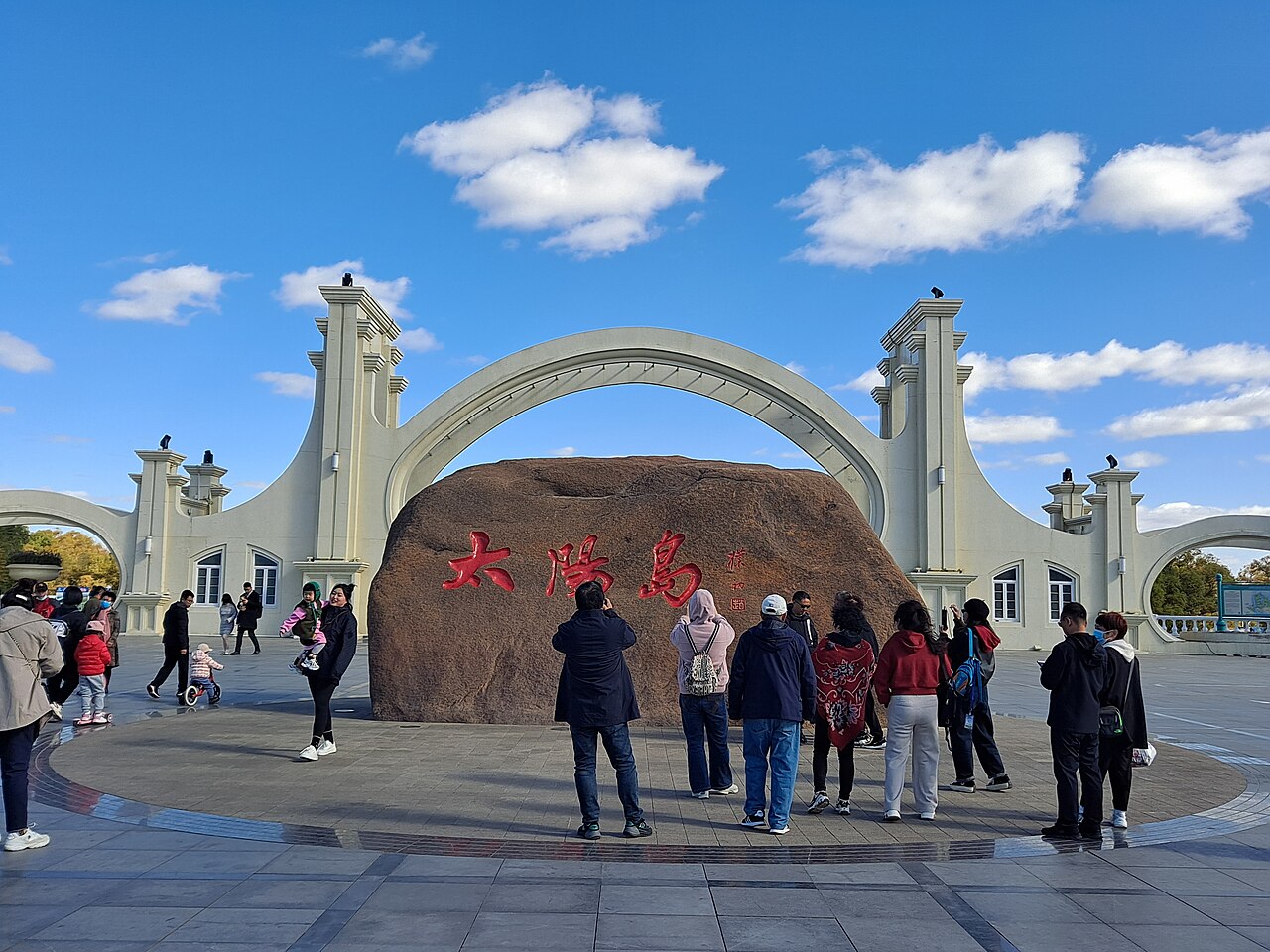
Sun Island is a river island in the middle of the Songhua, between Harbin's old and new districts, covering eighty-eight square kilometers — China's largest urban riverine ecological area and a national 5A scenic area. The island holds wide stretches of wetland, woodland, and river beach, the place Harbin people go to breathe on weekends. The origin of the name is disputed; one account traces it to a Manchu word for a kind of bream.
In summer Sun Island is all green, good for walking the riverbank, taking a boat, or watching the wetlands; in winter it becomes something else, hosting the Sun Island International Snow Sculpture Art Expo, with enormous snow sculptures standing in the snowfields. The island has sightseeing cars and walking paths; half a day is about right. In winter, wrap up well — the river wind makes it colder than the city center.
Ice and Snow World
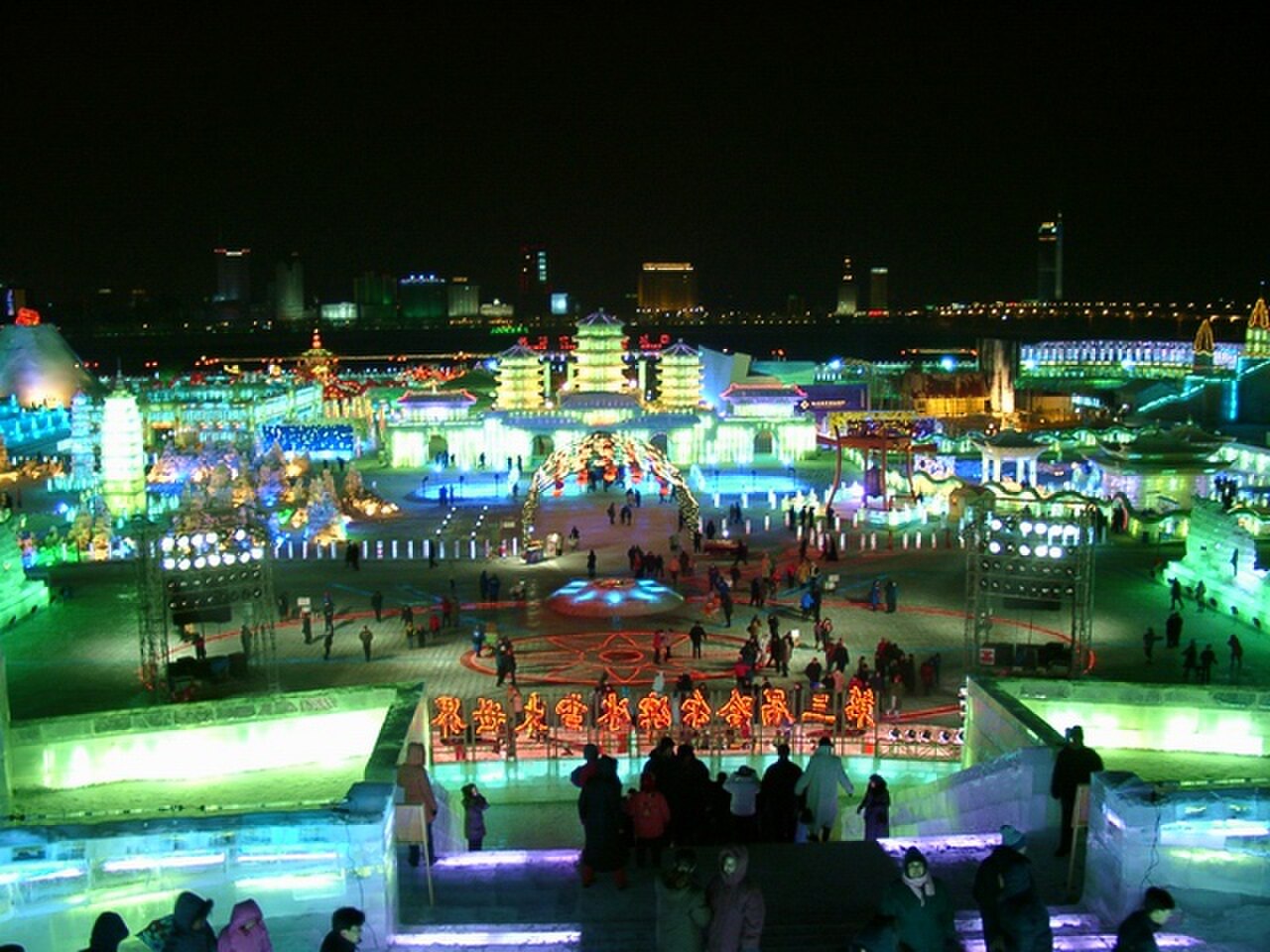
Ice and Snow World is Harbin's loudest winter calling card, a theme park built entirely of ice and snow, founded in 1999 and set on the west side of Sun Island on the Songhua's north bank. Each winter workers cut ice from the Songhua, slice it into blocks, and carve them into castles, towers, slides, and figures; at night, lit from within, the whole park turns into a crystal palace.
The park opens for only one winter each year, the sculptures lasting until the spring thaw. The long ice slides and on-ice attractions are the main event, with long queues, and the park is at its best after dark. Tickets are not cheap and the crowds are real, but it is worth seeing once in a lifetime. If you go at night, wear your warmest clothes — hat, gloves, and thick-soled shoes, none of them optional.
Flood Control Monument
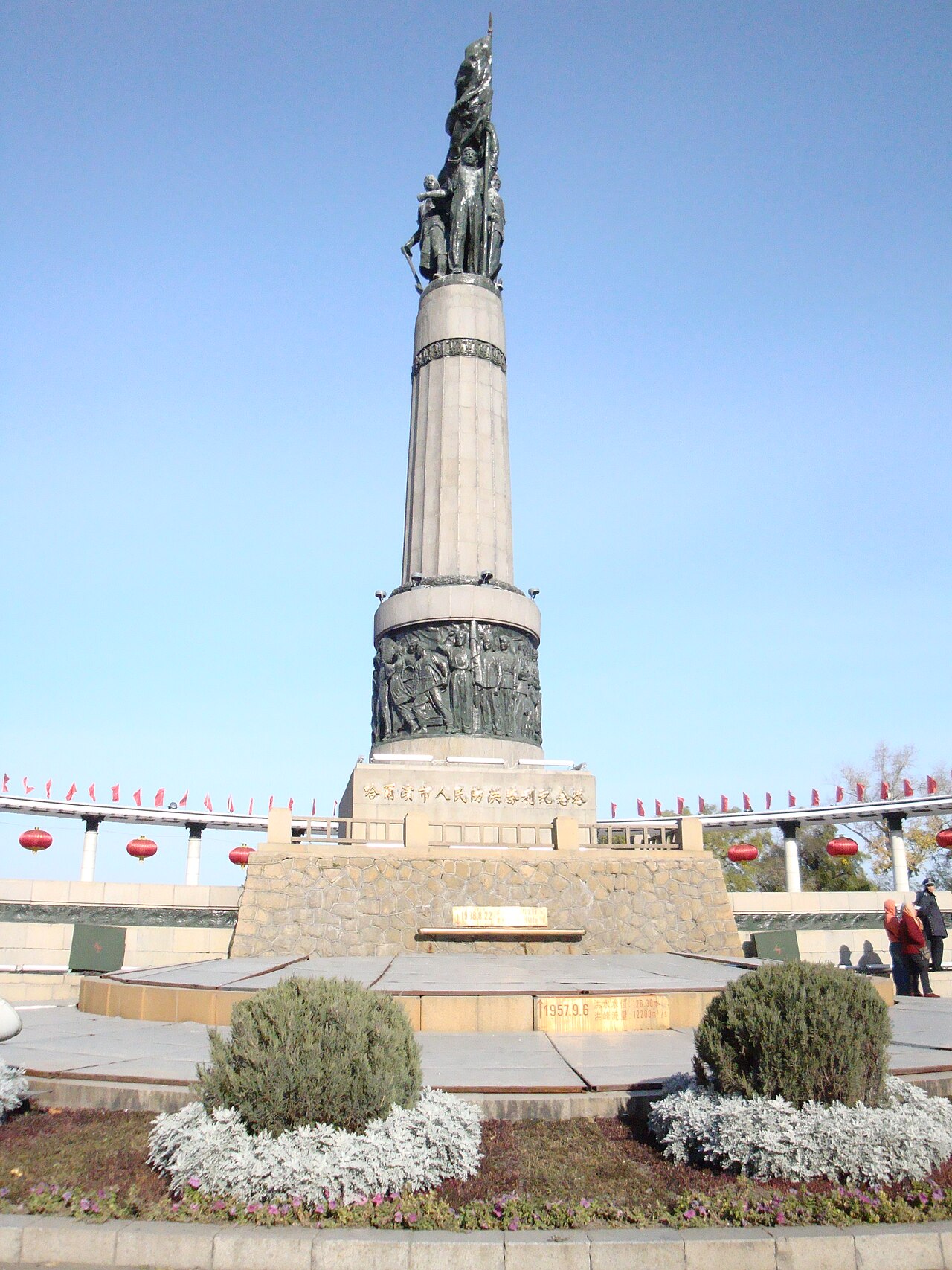
The Flood Control Monument stands on the bank of the Songhua, at the northern end of Central Street. In 1957 the Songhua burst into catastrophic flood, threatening the entire city; people across Harbin went up onto the levee and held the water back. To remember it, the government built this monument on the river dike, completed in 1958. The top and shaft carry human figures and reliefs depicting the fight against the flood.
The monument is now a Harbin landmark, and it guards the junction of Central Street and the Songhua. By day you go up onto the dike from here to see the river; by night the tower and the riverside lights come on together. It became a protected cultural relic of Harbin in 1995. Finish Central Street and you arrive here, ready to take in the river.
Eating in Harbin
Harbin's food carries a Russian and a northeastern flavor. Red sausage is the number-one specialty, heavy with garlic, eaten straight or cooked, with Qiulin and Haroulian as the two big brands. Dalieba is a huge Russian-style loaf, perfect with sausage and beer. Guobaorou — sweet-and-sour, crispy outside and tender within — is the face of northeastern cuisine, and many visitors come just for it. Pork stewed with vermicelli and the New Year pig-killing feast are proper northeastern home cooking, a hot bowl of either worth more than anything on a cold day. Russian cuisine has a tradition in Harbin; the old western restaurants serve proper borscht and stewed beef in a pot. In summer do not miss the Modern ice cream bar — and in winter people eat them anyway.
How to arrange the route
Three days is enough to get Harbin properly.
Day one, walk Central Street from south to north, stopping at St. Sophia Cathedral along the way, then the Flood Control Monument and the Songhua at dusk, and the night view of Central Street in the evening, with red sausage and Modern ice cream.
Day two goes entirely to Sun Island — wetland and river views in summer, snow sculptures in winter. The island is big; the sightseeing car saves your legs.
Day three: in winter, Ice and Snow World — gear up in the morning, enter in the afternoon and stay until the lights come on; in summer, swap in a Songhua cruise or the Chinese Baroque quarter of Laodaowai. In three days the face of the Ice City is essentially clear.
Things to confirm before you go
- Winter temperatures can hit minus twenty or thirty; a hat, gloves, thick-soled shoes, and a long down coat are essentials, not options.
- Ice and Snow World opens for one winter only, with opening dates and prices changing year to year — check before you go.
- St. Sophia Cathedral is an architecture museum inside; the exterior is free to view, with a ticket to enter.
- Sun Island is windy in summer and colder still in winter; plan island activities by season.
- Buy red sausage from proper branded packages, and ask before buying loose street sausage.
Frequently asked questions
How many days for Harbin?
Three is comfortable — a day for the Central Street area, a day for Sun Island, and a day for Ice and Snow World or the river.
When is the best time to visit Harbin?
December to February for ice and snow, June to August to escape the heat. The two seasons are entirely different experiences; pick the one you want.
Is Ice and Snow World worth it?
Yes. It is one of the largest ice-and-snow theme parks in the world and opens only one winter a year — a pity to skip it when visiting Harbin in winter. Just be ready for crowds, cold, and ticket prices.
Are Central Street and St. Sophia Cathedral close?
Very close, a few minutes' walk. The two, plus the Flood Control Monument, string neatly into one line.
Sources
The facts in this article were checked against the following Chinese Wikipedia entries, retrieved August 25, 2025.
- Harbin (city) https://zh.wikipedia.org/wiki/哈尔滨市
- Central Street https://zh.wikipedia.org/wiki/中央大街
- St. Sophia Cathedral https://zh.wikipedia.org/wiki/圣索菲亚教堂
- Sun Island (Harbin) https://zh.wikipedia.org/wiki/太阳岛_(哈尔滨)
- Harbin Ice and Snow World https://zh.wikipedia.org/wiki/哈尔滨冰雪大世界
- Flood Control Monument https://zh.wikipedia.org/wiki/防洪纪念塔
All photos are from Wikimedia Commons, used under CC licenses; re-use requires attribution.
- harbin-zhongyang.jpg from File Central Street at West 13th St (20230721112501).jpg, by N509FZ, CC BY-SA 4.0
- harbin-sophia.jpg from File West facade of St. Sophia Cathedral, Harbin (20230721150450).jpg, by N509FZ, CC BY-SA 4.0
- harbin-taiyangdao.jpg from File 哈尔滨太阳岛 2.jpg, by EditQ, CC BY-SA 4.0
- harbin-icecity.jpg from File Ice Snow World.jpg, by Lin Yang, CC BY-SA 3.0
- harbin-fanghong.jpg from File Harbin Memorial Tower.JPG, by Tlrmq, CC BY-SA 3.0